Polyester vs Polypropylene Filter Bags for Liquid Filtration
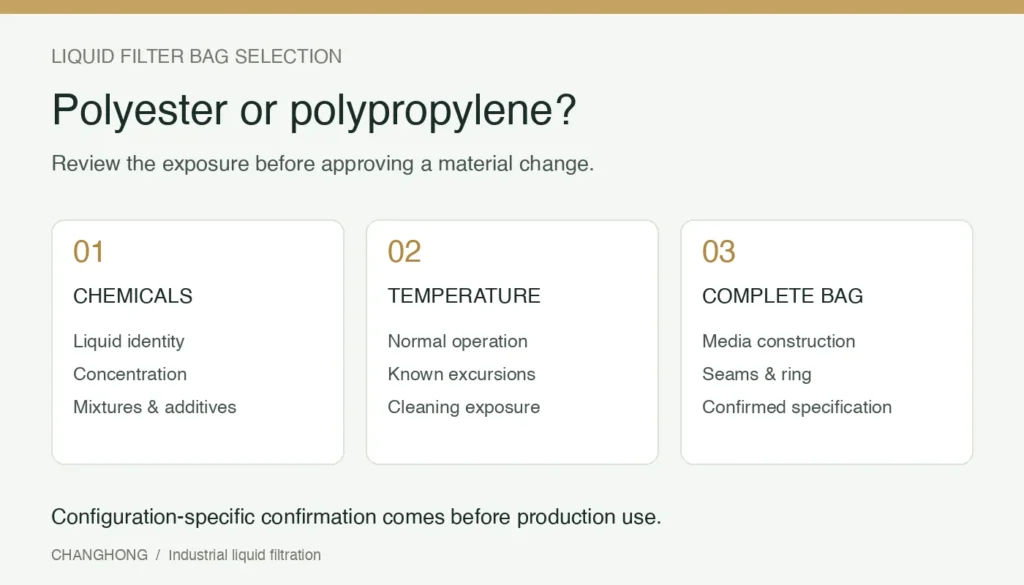
Choosing between polyester and polypropylene filter bags starts with the liquid and its operating temperature. Polypropylene is often a candidate for acid or alkaline service; polyester may offer a higher temperature allowance in a particular bag range. Neither observation approves a bag for your process. Confirm the actual chemical mixture, concentration and temperature against the finished bag specification before ordering.
This guide concerns industrial liquid filtration. Dust-collector bag comparisons describe a different operating duty and should not supply the limits for a liquid filter bag. The decision here is which media to submit for a compatibility review, not which material is universally better.
Compare the chemical and thermal duty together
A compatibility chart can narrow the shortlist, but a broad label such as “solvent resistant” leaves important questions unanswered. Record the liquid’s identity and concentration, including additives and contaminants that may affect the selection. For a mixture, provide its composition or the available product documentation rather than substituting one ingredient’s name for the whole liquid.
Read temperature and chemical guidance together. A material recommendation for one set of conditions does not establish suitability at another temperature. Include normal operation and any known excursions. If the bag remains installed during cleaning, identify the cleaning liquid and exposure conditions separately.
| Selection question | Polypropylene candidate | Polyester candidate |
|---|---|---|
| Acid or alkaline liquid? | Often worth screening; confirm the named chemical, concentration and temperature. | Check the specific exposure carefully, especially alkaline conditions; do not assume equivalence to PP. |
| Elevated liquid temperature? | Verify the finished bag’s documented temperature limit. | Some product ranges allow higher temperatures than PP, subject to chemical and configuration limits. |
| Solvent or mixed formulation? | Require compatibility evidence for the actual formulation. | Require the same evidence; “polyester” alone is not a solvent approval. |
| Same micron number on both offers? | Request construction and rating-basis information. | Compare those details before treating the offers as filtration equivalents. |
The table is a shortlist tool, not a chemical-resistance certificate or a set of operating limits. Obtain written confirmation for the proposed configuration. Where compatibility remains uncertain, ask the supplier what documented evaluation or representative exposure testing is needed before production use.
Specify the complete bag, not just the fabric
The material name is only one entry in a purchasing specification. Ask each supplier to identify the media construction, seam method, opening or ring material and any other wetted components. A statement about the fabric does not establish the suitability of every part of the finished bag.
Likewise, a material change should not silently change several other properties. If one offer is a different construction, size or rating basis, record the difference. A later operating comparison would then evaluate two complete configurations, rather than isolating polyester versus polypropylene.
Keep particle-removal requirements as a separate acceptance item. Our guide to choosing a liquid filter bag micron rating explains how to define the required result and compare rating information. Chemical compatibility does not prove that a bag meets that removal requirement.
Use the RD options as a starting point
CHANGHONG’s RD industrial liquid filter bags list polypropylene and polyester among the available media families. That listing establishes options for an inquiry; it does not mean both materials are suitable for every listed application.
The RD page calls for a configuration-specific data sheet for operating conditions. Ask for that document with the proposed media and bag details identified. Do not copy a temperature, pressure or chemical limit from an unrelated manufacturer’s bag into an RD purchase order.
For an existing installation, retain the approved housing-fit details while reviewing the material change. For a new installation, address the vessel configuration separately using the stainless steel filter housing selection guide. A compatible fabric does not establish that the complete assembly fits or meets the operating duty.
Resolve missing information before comparing prices
Consider this hypothetical purchasing situation: a buyer has two offers with the same nominal micron number, one polyester and one PP. The request says “water-based coating,” but omits additives and the cleaning procedure. Neither offer is ready for a material approval. The useful next step is to document those exposures and obtain a configuration review, rather than infer compatibility from “water-based.”
If both candidates pass that review, compare their quoted specifications and the evidence for the required filtration result. Any application trial should use an agreed procedure, equipment limits and acceptance criteria. Record differences in the complete configurations so the outcome is not mistakenly attributed to the polymer alone. This example illustrates a review sequence; it is not a customer case or a performance prediction.
Send a material-selection request that can be answered
Prepare the following information for the supplier:
- Exposure: liquid identity, concentration or mixture information, and relevant additives.
- Temperature: normal conditions, known excursions and any cleaning exposure while the bag remains installed.
- Current specification: media, construction, rating, bag configuration and available drawings or part details.
- Reason for the review: a changed liquid, a changed process condition, an uncertain existing specification or an alternative quotation.
- Required evidence: the proposed configuration’s data sheet, compatibility confirmation and any application-specific documentation you need.
Mark unknown information explicitly. Request clarification before approving a material substitution, and preserve the confirmed specification for repeat orders. You can use Technical Resources to organize the available documentation, then send the requirements through the RD product page’s inquiry form.